

Counting the wrong thing: what the AFL Grand Final is really worth to Victoria
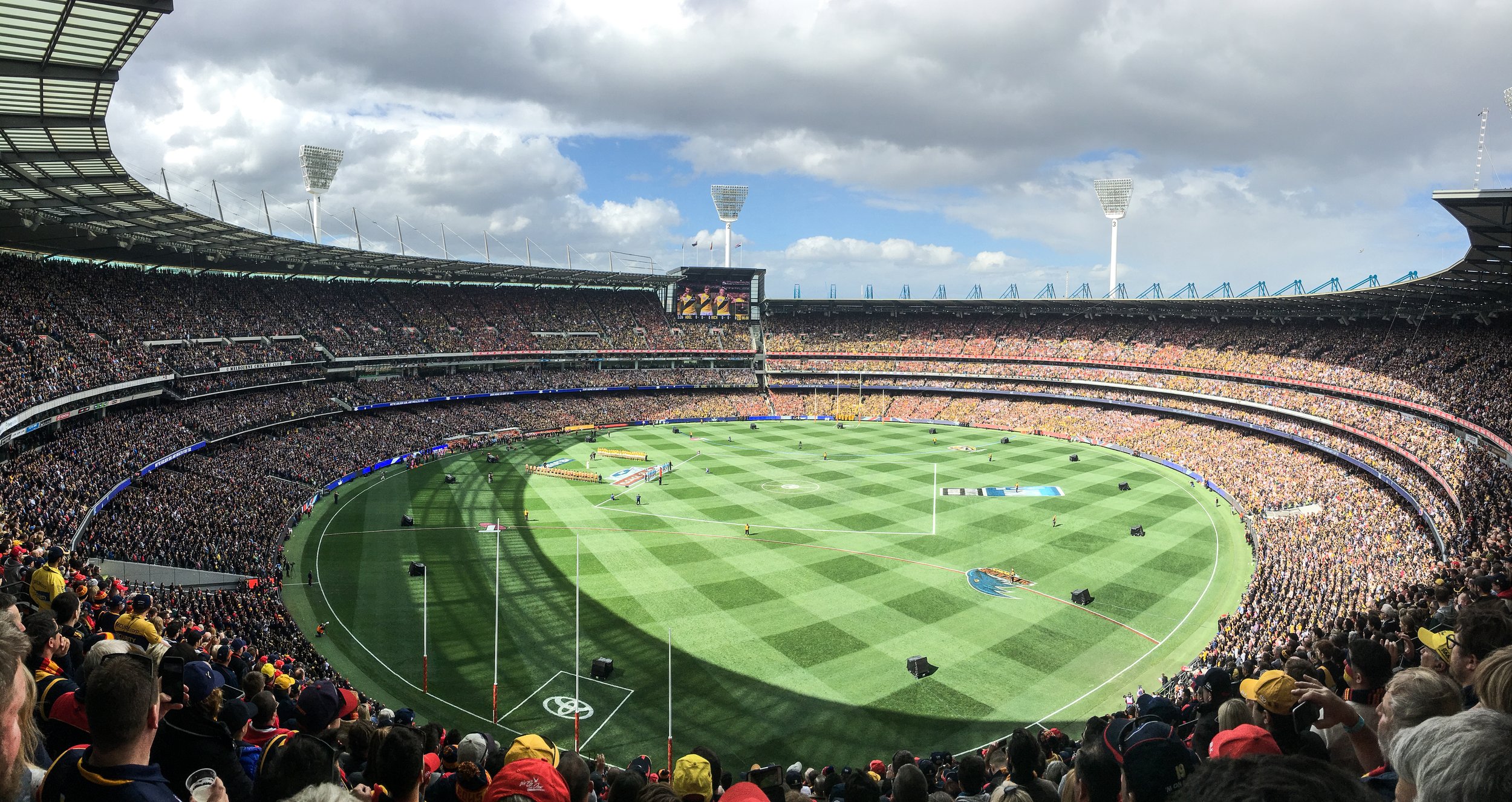
Every September, the same question turns up in the Melbourne media, like a well-worn scarf pulled out of the wardrobe. This year an Economics Professor estimates that Grand Final weekend could generate up to $75 million in economic activity for Victoria. With Fremantle and Brisbane contesting today’s decider, the argument runs that an all-interstate Grand Final is actually better for the state’s coffers. Travelling fans fill hotels and restaurants, while Melburnians merely move their spending from one pub to another. The Professor is right about the direction. Where I part company with the conversation is its destination. We have become very good at counting receipts, and not very good at counting value.
First, the receipts, done properly
Let me run the economists’ logic to its honest conclusion, because it is more interesting than the headline. Take two scenarios for a 100,000 crowd. In the first, 90 per cent of attendees live in Melbourne. In the second, half have travelled from interstate. Allow each visitor two hotel nights plus food, drink and some tourism, and include the companions who come for the parade and the pub rather than the game. That is roughly $900 per head spent in the state. The headline activity figures come out at around $25 million and $66 million respectively. The second is close to the Economics Professor’s number, which tells me the estimate is a plausible gross figure, especially if you add a third hotel night to the scenario.
Now apply the three filters that separate new money from redirected money. Substitution: local fans spend at the MCG instead of somewhere else in Victoria, a net effect close to zero. Deadweight: some visitors would have come anyway, particularly in school holidays. Crowding-out: Grand Final hotel rates push out the tourists and business travellers who would otherwise have filled those rooms. Then convert turnover into value added, because a dollar through the till is not a dollar of income.
On my back-of-envelope numbers, the interstate Grand Final delivers something like $20 million of genuinely new value to Victoria, against perhaps $4–5 million for a locally dominated one. That is four to five times more, which is a real difference. But it is also about a third of the headline. And from a national perspective, most of it is a transfer: Perth and Brisbane household budgets are funding Melbourne’s hotel occupancy this weekend. Some of those budgets have been stretched by return airfares reported at up to $6,000, and very little of that money stays in Victoria.
None of this is new to economists. The literature has warned for decades that ex-ante impact studies overstate their case, and Victoria learned the lesson expensively with the Commonwealth Games. As I wrote at the time of the cancellation, the measurable costs were clear, but the intangible costs were equally significant. That point cuts both ways, and it is the one I want to develop here.
The problem with a single currency
Economic impact analysis measures one thing: money that crosses a border. It is blind to almost everything else that makes sport valuable, and it says nothing about who ends up holding the value it does count. Consider the counter-intuitive implication of the numbers above. By impact logic, an all-Victorian Grand Final is the worse outcome for the state. Yet ask any Melburnian whether they would rather see two Victorian clubs on the last Saturday in September, or two interstate clubs they have no stake in. The Treasury answer and the human answer point in opposite directions. When that happens, it is the measurement framework that is wrong, not the fans.
The Sport Value Architecture, applied to one Saturday in September
In my new article in Frontiers in Sports and Active Living, Value creation in sport business in the age of AI: a multidimensional framework, I set out what I call the Sport Value Architecture. Its starting point is that everyone appeals to the value of sport, and almost everyone means something different. The Grand Final debate is a textbook case. Here is what the framework adds.
Three types of value, in a fixed order. Sport creates three logically distinct types of value: competitive, commercial and social. They are not interchangeable, and they are not equal. Competitive value, the genuine contest with an uncertain outcome and real stakes, is the strict precondition for everything commercial. There would be no $75 million without a match that matters, played in earnest by 46 players whose effort cannot be scripted. The economic impact figure is entirely derivative of a sporting contest that the impact study never mentions.
Social value is different again. It is the collective benefit beyond the transaction: identity, belonging, shared ritual, civic pride. Our research with Dutch colleagues on how people experience sport events (Hover, Heijnen, Tiesen-Raaphorst & Westerbeek, 2020), and the experience-design guide I co-authored with Andrew O’Loughlin and Paul Hover (2024), both show that this is where much of an event’s lasting worth resides. A city that stops for a football match, even between two teams from elsewhere, is performing an identity. An all-Victorian Grand Final would create far more social value for Victorians. The impact study scores that as a loss.
Four stakeholder groups, and asymmetric capture. The more important question is not what value is created, but who captures it. The framework cross-tabulates the three value types against four stakeholder groups: athletes and participants, fans and communities, commercial partners, and governments and civil society. Do that for Grand Final weekend and the picture sharpens considerably. Commercial partners (hotels, hospitality, broadcasters, airlines, the league) capture most of the commercial value. Fans do not capture commercial value at all; they supply it, in money and attention, and take home the experiential and identity value in return. Government captures commercial value only indirectly, through taxes and jobs, and rarely in proportion to the public investment in stadiums, transport and a public holiday that make the whole thing possible.
The $6,000 airfare is the cleanest illustration of the point. Two clubs, their players and their supporters create the value of the occasion. Travel and accommodation booking algorithms owned by someone else captures a large slice of it. In the article I put this as a proposition: capture shifts towards whoever owns the data, the platform or the algorithm mediating the exchange, regardless of who created the underlying value. Yield-management software pricing a Perth fan’s flight to Melbourne is exactly that dynamic, operating in plain sight. It is also something few economic impact studies measure.
Legitimacy is an outcome, not a deliverable. Beneath the whole structure sit three enabling conditions: governance quality, environmental responsibility, and equity of access. They are not extra columns to be traded off against revenue. They are the floor on which legitimate value creation rests. Applied to the Grand Final, they raise questions the $75 million headline does not. Governance: are the public holiday, the long-term venue arrangements and the event funding ever evaluated after the fact, transparently and independently? Environment: what is the carbon cost of flying tens of thousands of supporters across the continent, and does anyone count it? Equity: when hotel and airfare pricing reaches these levels, which fans are priced out of following their club to the biggest game of their lives?
When an event keeps reporting impressive numbers while those conditions go unexamined, it does not accumulate legitimacy. It accumulates what I call legitimacy debt, which is carried quietly until the day someone tests the substance behind the claim. The Commonwealth Games cancellation showed what happens when that day arrives.
Measuring what matters, finally
There is an irony here. For decades we relied on modelled impact numbers because measuring the real thing was too hard. That excuse has expired. Anonymised card-transaction data, mobile location data and hotel yield data now allow us to measure what actually happened after an event, not what we hoped would happen before it. The same AI tools that personalise the fan experience can be pointed at the social side of the ledger: sentiment, belonging, repeat engagement, access. As I argued in my earlier work on algorithmic fandom, the question is whether those tools are deployed to understand and serve fans, or simply to extract more from them.
So my challenge to governments, event agencies and the AFL is straightforward. Keep counting the receipts, but count them honestly and after the event, not only before it. Ask who captures the value, not just how much of it there is. And treat governance, environmental responsibility and access as the conditions of the event’s legitimacy, not as optional extras. The most valuable thing a Grand Final creates for Victorians was never going to fit inside a $75 million headline.
Enjoy the game today, whoever you are barracking for. Just remember that the most valuable thing happening at the MCG will not appear in anyone’s economic impact study.
Hans Westerbeek is Professor of Sport, Business and AI at Victoria University, Melbourne.
Westerbeek, H. (2026). Value creation in sport business in the age of AI: a multidimensional framework. Frontiers in Sports and Active Living, 8:1927685. https://doi.org/10.3389/fspor.2026.1927685