
What a gold medal winning Olympic rowing coach taught me about AI and intuition
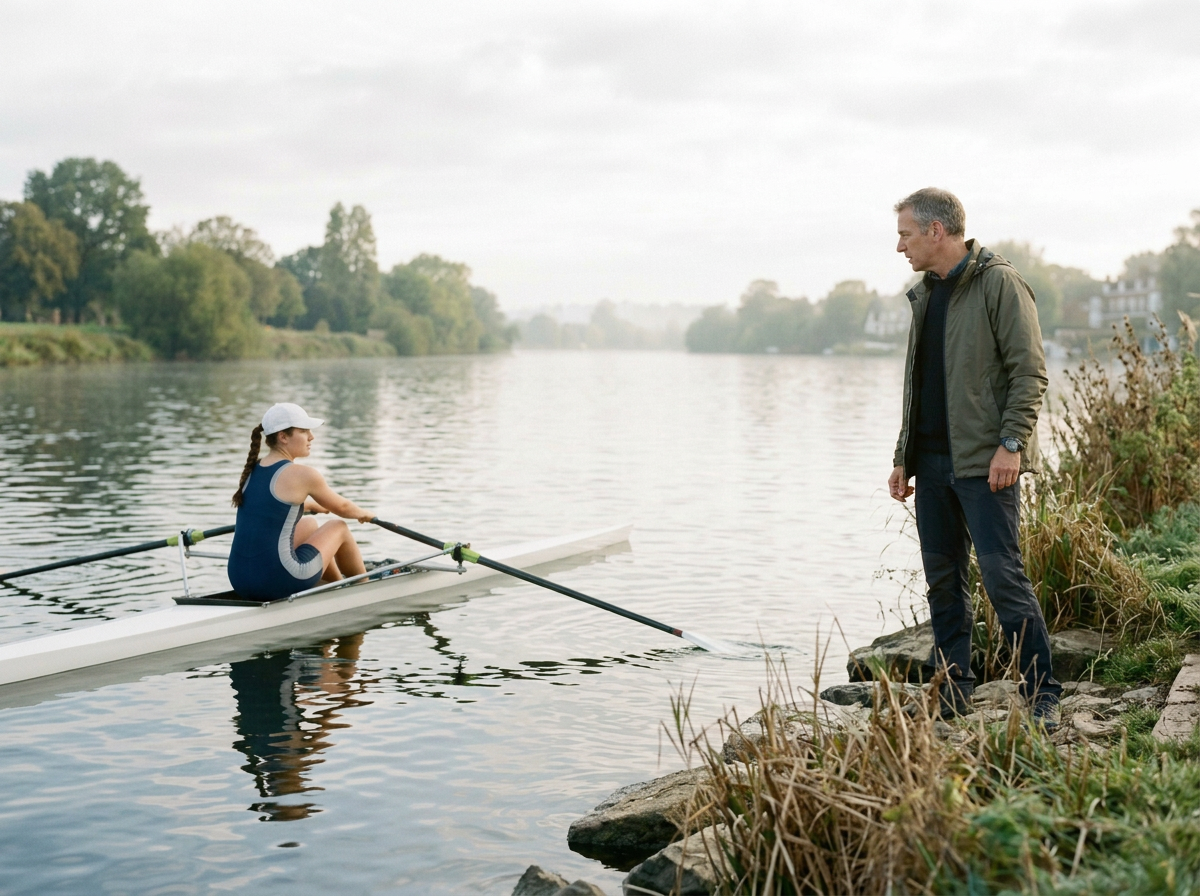
A few weeks ago, I was sent an essay by Koen de Haan, an exercise physiologist and high-performance coach who worked with Karolien Florijn and Simon van Dorp in the build-up to their medals at the Paris Olympics. The essay, De volgende noot ("The Next Note"), asks a deceptively simple question: how do coaches actually make the decisions that matter, in the seconds where there is no manual, and what happens to that skill as AI enters the boat?
What struck me is that De Haan arrived at a version of my own argument in AI & Society, from a completely different direction, and by way of a rowing lake near Paris rather than a classroom.
His essay opens with two moments no coaching handbook prepares you for. Karolien Florijn, unbeaten for three years and the outright favourite for gold, wakes up with a fever the day before travelling to Paris. Simon van Dorp is deep into his warm-up for the race he has dreamed about his whole career when the final is postponed by half an hour (which in the end ended up being a one hour delay). In both cases, someone had to decide, fast, with everything at stake, and no rulebook to consult.
De Haan's answer is that this kind of decision is never invented on the spot. It is drawn from a repertoire: thousands of earlier situations, similar enough to this one, distilled into a recognition that simply presents itself. He leans on Gary Klein's classic work on naturalistic decision-making, and on the joint conclusions Klein reached with Daniel Kahneman after years of arguing from opposite ends of the intuition debate: expert intuition is real, but it is only trustworthy where the environment gives reliable signals and the person has had the time, and the curiosity, to learn to read them. Where either condition is missing, what looks like intuition is really just confidence with nothing underneath it.
The image De Haan uses to explain how that repertoire gets built is the one I can't stop thinking about. For years, before software could do it for him, he analysed training data by hand in Excel: speeds, heart rates, watts, row by row (excuse the pun). Eventually he kept doing it by hand on purpose, because the slow, manual work of connecting this load to that response is exactly what laid the pattern down in his head. He compares it to John Coltrane practising scales so obsessively that he is said to have fallen asleep with the saxophone still in his hands, internalising them so completely that he no longer had to think about them at all. The analysis of today, as De Haan puts it, is the intuition of five years from now.
This is where his essay turns to my research, and where the two arguments meet. My paper on cognitive rewiring, and its companion piece on designing for cognitive resilience in education, make a claim that has nothing to do with sport on its surface: generative AI is lowering the cost of the attention, retrieval, reasoning and judgement that learning is supposed to build, and education systems risk mistaking the resulting fluent output for the real thing. De Haan reads that claim and recognises, correctly, that it is also a description of what happens the moment a coach lets a dashboard do the pattern-recognition work the spreadsheet used to do. Friction is the training stimulus. For the rowers in the boat… and for the coach on the shore. Remove it, and you don't lose intelligence, you lose the repetitions that would have built judgement in the first place.
He draws out a distinction from my paper that I think coaches, and not only coaches, should sit with: the difference between knowing and retrieving. Retrieving is being able to look something up, or have a system generate it. Knowing is being able to explain it, apply it, connect it, and argue with it. An AI system can hand you a training schedule in a second. Whether that schedule is right for this rower, after this altitude camp, with this recovery pattern, is not something you can retrieve. It has to be known, and knowing is built the slow way, the way De Haan built his own repertoire, one row of a spreadsheet at a time.
What I find genuinely useful in his essay is that he doesn't let either side of the picture win outright, and neither do I. AI, used well, is what decision research calls a decision amplifier: it speeds up analysis at exactly the moment a coach has recognised the edge of their own knowledge, and in doing so it sharpens judgement rather than replacing it. Used badly, it becomes a substitute for the recognition itself, and the coach quietly shifts from decision-maker to validator of whatever the system proposes. The tool is identical in both cases. The difference is a choice, and De Haan is right that the choice tends to come from the same place that builds expertise in the first place: curiosity, the willingness to keep asking whether a rule of thumb still holds or is just habit wearing the costume of experience.
De Haan closes his essay by referring to the Dunning-Kruger effect which is the tendency for people with limited knowledge or skills in a domain to overestimate their competence, because the same lack of expertise that produces poor performance also prevents them from recognising how poor it is. The Dunning-Kruger curve then offers a twist worth keeping: the peak of false confidence and the plateau of real wisdom are not two types of people, they are two positions the same expert can occupy depending on the decision in front of them. A coach can stand on solid ground reading a rower's fatigue, because that judgement rests on a thousand repetitions, and stand on nothing at all making a call in a domain where the feedback is unreliable or the data thin. Knowing which mountain you're on, before you decide rather than after, is what he calls the real art of expertise. AI, he argues, offers to lift us off every mountain at once, with no climb required. But the climb is what builds the judgement worth trusting once you're up there.
I didn't write my paper with rowing lakes or saxophones in mind. But it's a genuine pleasure to see the same warning arrive independently from a coach who has stood beside an athlete with a fever the morning before an Olympic final, and to find that we ended up asking the same question from opposite ends of the field: if a machine offers to save us the climb, who still chooses to take it, and who stays the author of the judgement that matters when nobody can look it up in a book?
This post draws on Koen de Haan's essay De volgende noot: intuïtie, jazz en AI: besluitvorming in de topsport met de kennis van nu op weg naar 2040, which itself engages with my paper Westerbeek, H. (2026), "How AI is rewiring the human brain: the generational transformation of cognition and knowing," AI & Society, https://doi.org/10.1007/s00146-026-02912-2, and its companion piece "Designing for cognitive resilience: a distributed cognition approach to education in the age of generative AI," AI & Society, https://doi.org/10.1007/s00146-026-03284-3.